All free downloads

Transport manager’s compliance calendar, free to print.

Every recurring duty on one page: what is due each day and week, every 28 and 90 days, every year and every five years, how long to keep each record, and a 12 month planner to tick off.

  • Duties grouped by frequency, from daily to every five years
  • Each one marked as a rule, DVSA guidance or a suggested routine
  • What to do when a driver, a vehicle or the business changes
  • A retention table and a 12 month tick-off planner
First page of the FleetInspect transport manager’s compliance calendar

Get the PDF

Tell us who you are and the sheet is yours.

Your details go to our team by email. Unless you tick the box, we will not use them to market to you. See our privacy policy.

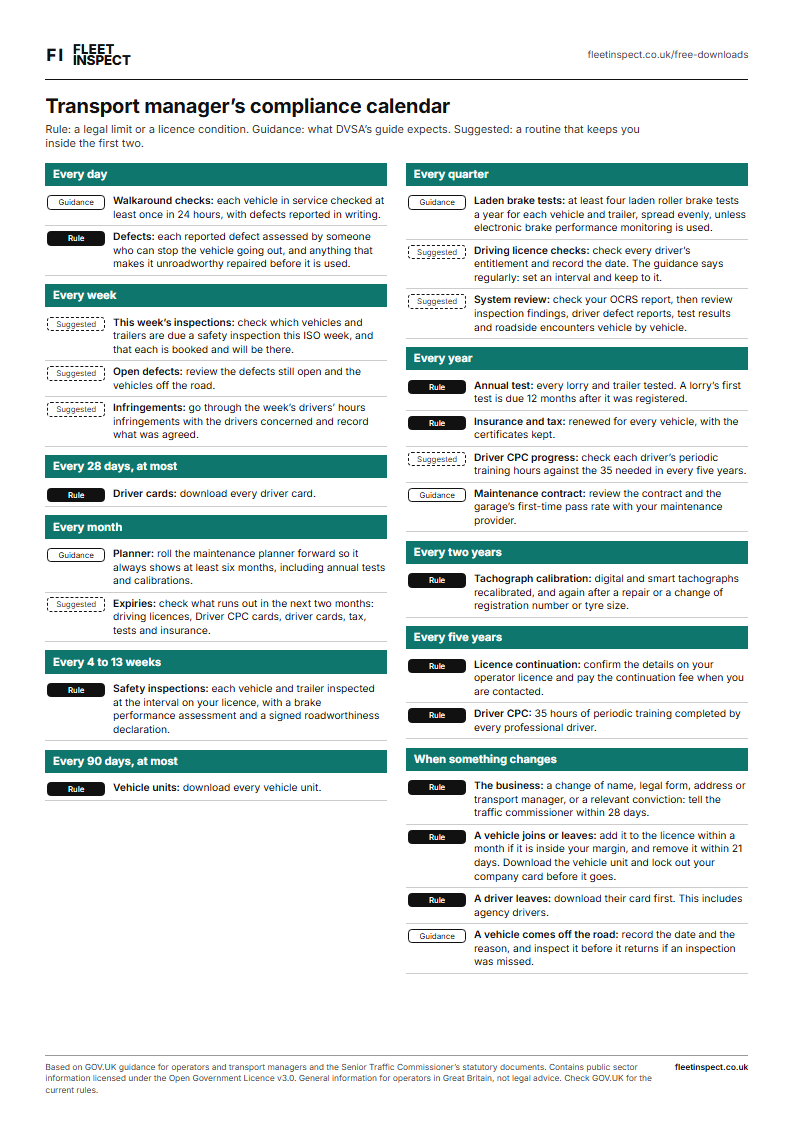
Transport manager’s compliance calendar

Rule: a legal limit or a licence condition. Guidance: what DVSA’s guide expects. Suggested: a routine that keeps you inside the first two.

Every day

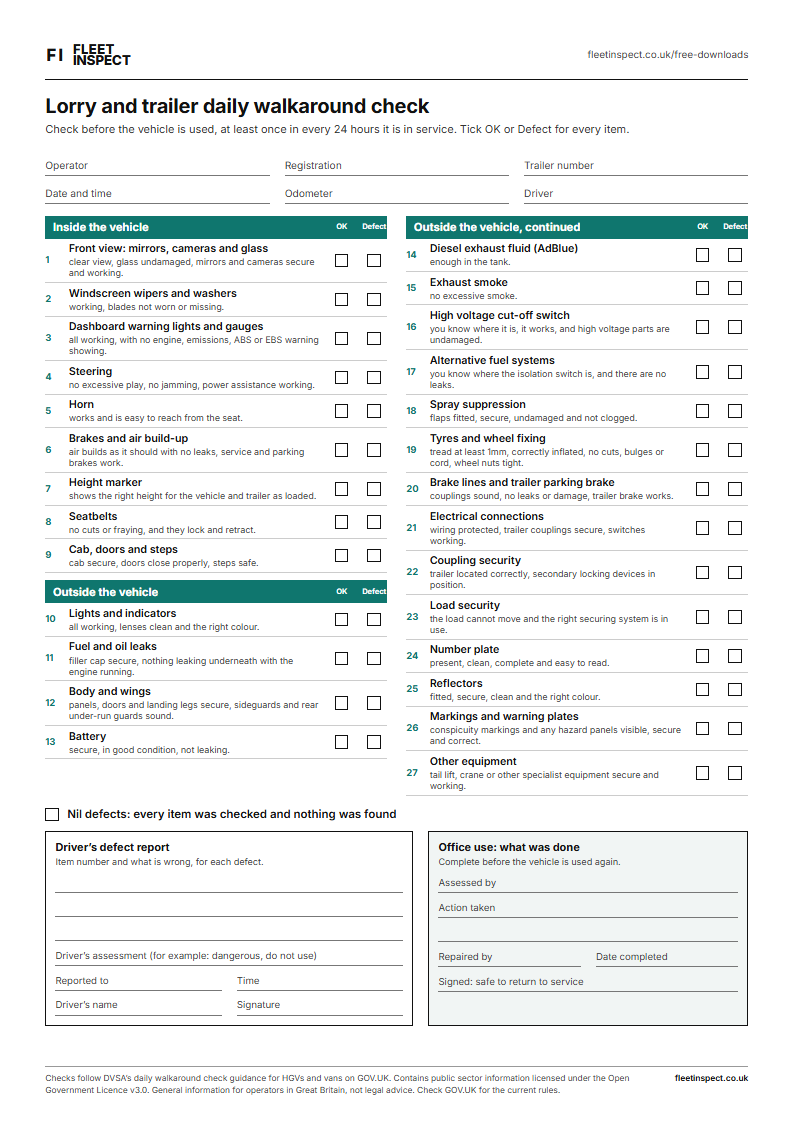
  • GuidanceWalkaround checks: each vehicle in service checked at least once in 24 hours, with defects reported in writing.
  • RuleDefects: each reported defect assessed by someone who can stop the vehicle going out, and anything that makes it unroadworthy repaired before it is used.
Every week

  • SuggestedThis week’s inspections: check which vehicles and trailers are due a safety inspection this ISO week, and that each is booked and will be there.
  • SuggestedOpen defects: review the defects still open and the vehicles off the road.
  • SuggestedInfringements: go through the week’s drivers’ hours infringements with the drivers concerned and record what was agreed.

Every 28 days, at most

  • RuleDriver cards: download every driver card.

Every month

  • GuidancePlanner: roll the maintenance planner forward so it always shows at least six months, including annual tests and calibrations.
  • SuggestedExpiries: check what runs out in the next two months: driving licences, Driver CPC cards, driver cards, tax, tests and insurance.

Every 4 to 13 weeks

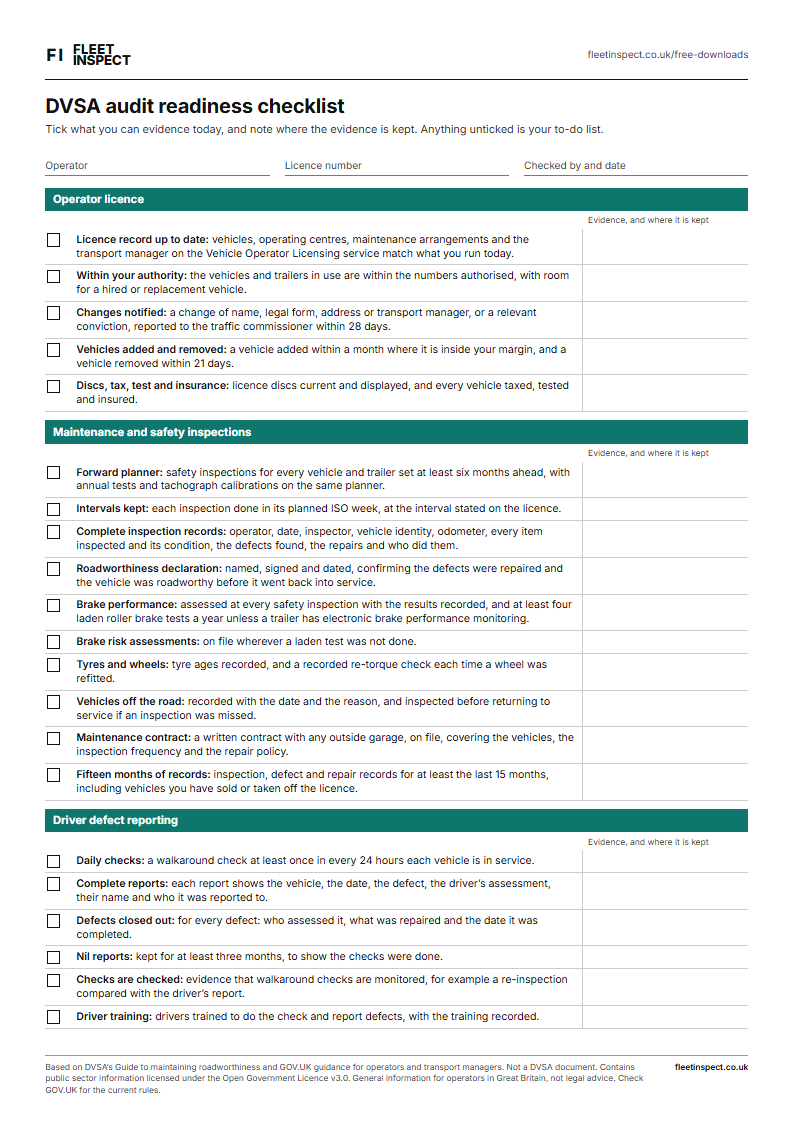
  • RuleSafety inspections: each vehicle and trailer inspected at the interval on your licence, with a brake performance assessment and a signed roadworthiness declaration.

Every 90 days, at most

  • RuleVehicle units: download every vehicle unit.

Every quarter

  • GuidanceLaden brake tests: at least four laden roller brake tests a year for each vehicle and trailer, spread evenly, unless electronic brake performance monitoring is used.
  • SuggestedDriving licence checks: check every driver’s entitlement and record the date. The guidance says regularly: set an interval and keep to it.
  • SuggestedSystem review: check your OCRS report, then review inspection findings, driver defect reports, test results and roadside encounters vehicle by vehicle.

Every year

  • RuleAnnual test: every lorry and trailer tested. A lorry’s first test is due 12 months after it was registered.
  • RuleInsurance and tax: renewed for every vehicle, with the certificates kept.
  • SuggestedDriver CPC progress: check each driver’s periodic training hours against the 35 needed in every five years.
  • GuidanceMaintenance contract: review the contract and the garage’s first-time pass rate with your maintenance provider.

Every two years

  • RuleTachograph calibration: digital and smart tachographs recalibrated, and again after a repair or a change of registration number or tyre size.

Every five years

  • RuleLicence continuation: confirm the details on your operator licence and pay the continuation fee when you are contacted.
  • RuleDriver CPC: 35 hours of periodic training completed by every professional driver.

When something changes

  • RuleThe business: a change of name, legal form, address or transport manager, or a relevant conviction: tell the traffic commissioner within 28 days.
  • RuleA vehicle joins or leaves: add it to the licence within a month if it is inside your margin, and remove it within 21 days. Download the vehicle unit and lock out your company card before it goes.
  • RuleA driver leaves: download their card first. This includes agency drivers.
  • GuidanceA vehicle comes off the road: record the date and the reason, and inspect it before it returns if an inspection was missed.

Getting the most from the transport manager’s compliance calendar

  1. Put your own intervals on it: the safety inspection interval is the one on your licence, and the licence check interval is the one you choose. Write both on the sheet.
  2. Give every line a name: a duty that belongs to the office in general belongs to nobody. Put a person against each line and a second person for when they are away.
  3. Tick the planner each month: the grid on the second page takes one tick a month per duty. A row of blanks is the earliest warning you will get.
  4. Keep last year’s: a filled-in planner is evidence that the system is monitored, which is what DVSA’s guide asks for.

From a wall chart to reminders

A calendar on the wall works while the person who reads it is in the office. The dates that hurt are the ones that fall in a holiday week: a driver card at day 27, a calibration, a vehicle due its inspection while it is away.

In FleetInspect the dates come to you instead. Driver documents remind the driver and their managers from 30 days before they expire, and each inspection, MOT and calibration sends a notice to your maintenance group before it falls due.

Common
questions.

How often must tachograph data be downloaded?

In Great Britain, each driver card at least every 28 days and each vehicle unit at least every 90 days. A driver’s card must also be downloaded before they leave, agency drivers included, and a vehicle unit before the vehicle passes to someone else.

How often are safety inspections due?

At the interval stated on your operator licence. DVSA’s guide gives a range of 4 to 13 weeks depending on the work, with 6 weeks for a vehicle or trailer 12 years old or more, and expects the dates to be planned at least six months ahead.

How often should driving licences be checked?

The statutory guidance for transport managers says regular checks must be carried out and does not set an interval. Choose one, write it down, apply it to every driver and record the date of each check.

How long must transport records be kept?

Safety inspection, defect and repair records for at least 15 months. Drivers’ hours records for at least 12 months and working time records for at least 24 months. Nil defect reports are recommended to be kept for at least three months.

What do I have to tell the traffic commissioner, and when?

For a standard licence, a change of name or legal form, address or transport manager, and a conviction of the operator or an employee, within 28 days. A vehicle taken off the licence within 21 days, and one added within a month where it is inside your margin. A change of maintenance contractor should be notified as soon as possible.

Sources

Based on GOV.UK guidance for operators and transport managers and the Senior Traffic Commissioner’s statutory documents. Contains public sector information licensed under the Open Government Licence v3.0.

General information for operators in Great Britain, not legal advice. Rules change: check the current position on GOV.UK before relying on it. In Northern Ireland the DVA and the Department for Infrastructure apply their own versions of these rules, and in Ireland the Road Safety Authority does.

Let’s talk about
your business.

Book a free, no-obligation demo and see how FleetInspect can transform your operations. One email is all it takes.

Email us

The link opens a ready-made email in your mail app. Tell us a little about your business and we’ll come back with demo times.

Prefer to call?
We reply within one working day