All free downloads

DVSA audit readiness checklist, free to print.

A self-check for operator licence holders: the points an examiner can ask about in a desk-based or fleet assessment, grouped the way the records are, with a column for where your evidence is kept.

  • Six sections: licence, maintenance, defect reports, drivers, drivers’ hours and monitoring
  • A tick box and an evidence column for every point
  • The retention period for each kind of record
  • What DVSA’s two kinds of assessment are and how each affects your risk score
First page of the FleetInspect dvsa audit readiness checklist

Get the PDF

Tell us who you are and the sheet is yours.

Your details go to our team by email. Unless you tick the box, we will not use them to market to you. See our privacy policy.

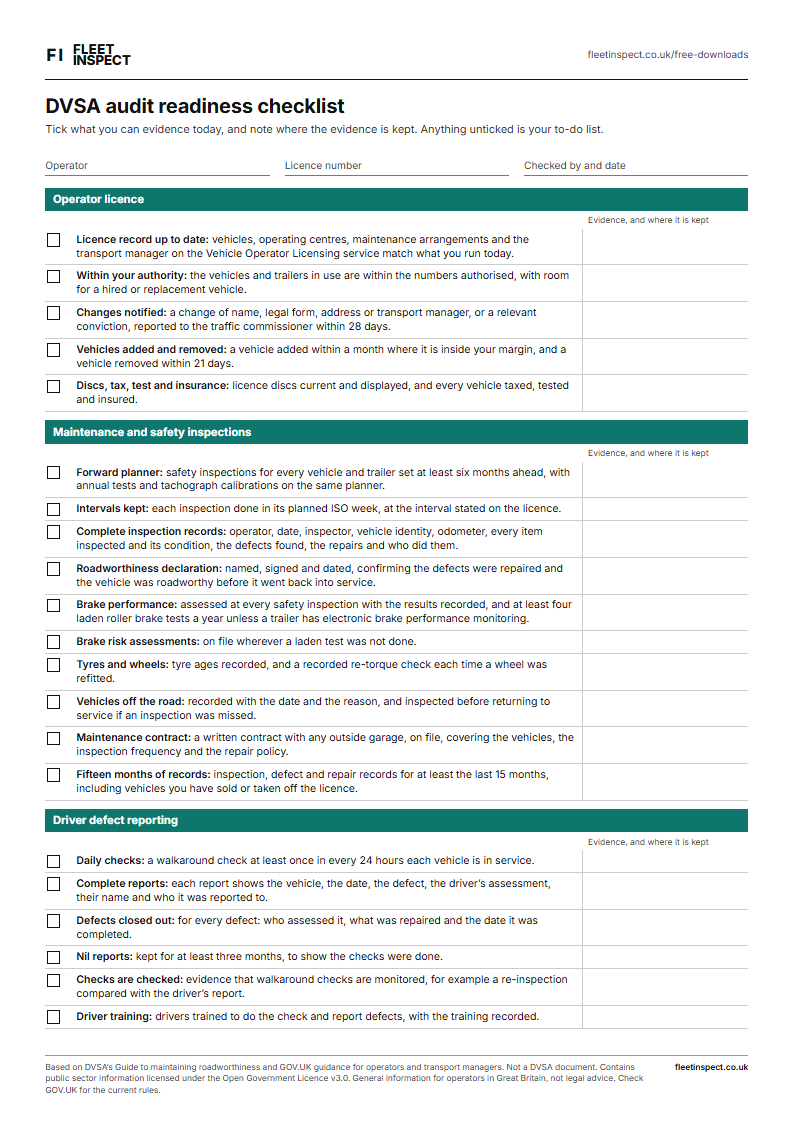
DVSA audit readiness checklist

Tick what you can evidence today, and note where the evidence is kept. Anything unticked is your to-do list.

Operator licence

  • Licence record up to date: vehicles, operating centres, maintenance arrangements and the transport manager on the Vehicle Operator Licensing service match what you run today.
  • Within your authority: the vehicles and trailers in use are within the numbers authorised, with room for a hired or replacement vehicle.
  • Changes notified: a change of name, legal form, address or transport manager, or a relevant conviction, reported to the traffic commissioner within 28 days.
  • Vehicles added and removed: a vehicle added within a month where it is inside your margin, and a vehicle removed within 21 days.
  • Discs, tax, test and insurance: licence discs current and displayed, and every vehicle taxed, tested and insured.
Maintenance and safety inspections

  • Forward planner: safety inspections for every vehicle and trailer set at least six months ahead, with annual tests and tachograph calibrations on the same planner.
  • Intervals kept: each inspection done in its planned ISO week, at the interval stated on the licence.
  • Complete inspection records: operator, date, inspector, vehicle identity, odometer, every item inspected and its condition, the defects found, the repairs and who did them.
  • Roadworthiness declaration: named, signed and dated, confirming the defects were repaired and the vehicle was roadworthy before it went back into service.
  • Brake performance: assessed at every safety inspection with the results recorded, and at least four laden roller brake tests a year unless a trailer has electronic brake performance monitoring.
  • Brake risk assessments: on file wherever a laden test was not done.
  • Tyres and wheels: tyre ages recorded, and a recorded re-torque check each time a wheel was refitted.
  • Vehicles off the road: recorded with the date and the reason, and inspected before returning to service if an inspection was missed.
  • Maintenance contract: a written contract with any outside garage, on file, covering the vehicles, the inspection frequency and the repair policy.
  • Fifteen months of records: inspection, defect and repair records for at least the last 15 months, including vehicles you have sold or taken off the licence.

Driver defect reporting

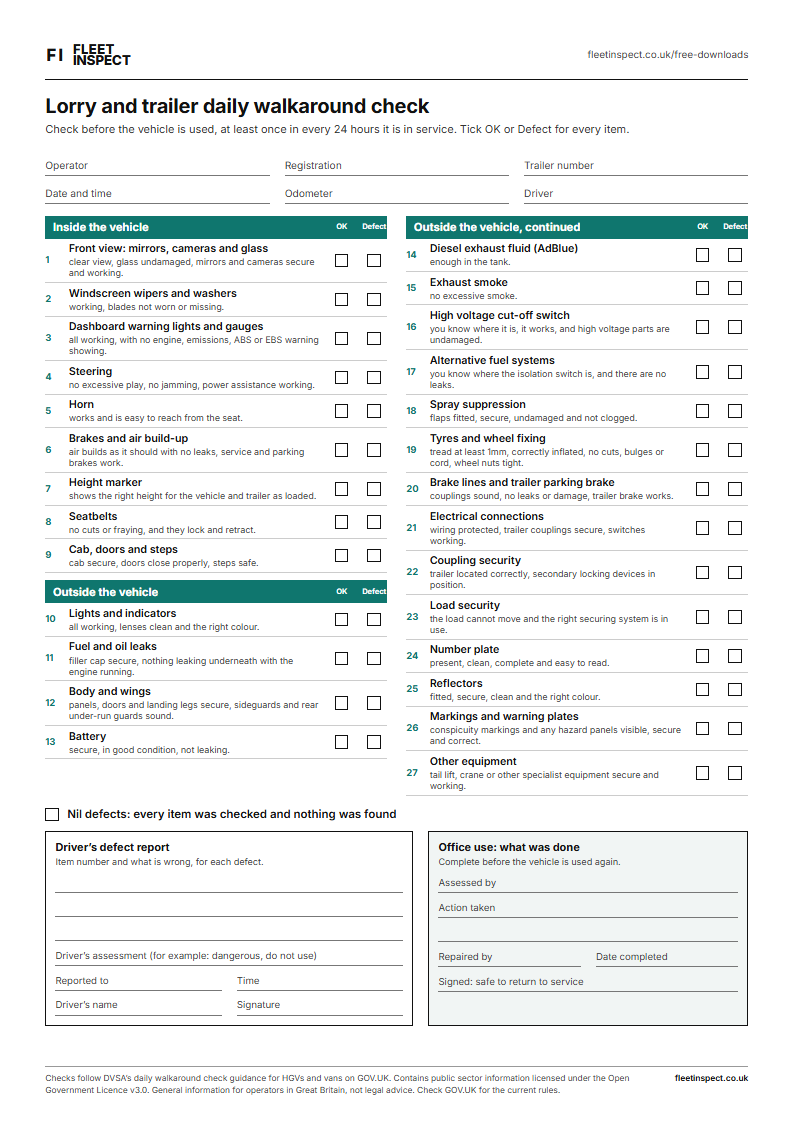
  • Daily checks: a walkaround check at least once in every 24 hours each vehicle is in service.
  • Complete reports: each report shows the vehicle, the date, the defect, the driver’s assessment, their name and who it was reported to.
  • Defects closed out: for every defect: who assessed it, what was repaired and the date it was completed.
  • Nil reports: kept for at least three months, to show the checks were done.
  • Checks are checked: evidence that walkaround checks are monitored, for example a re-inspection compared with the driver’s report.
  • Driver training: drivers trained to do the check and report defects, with the training recorded.

Drivers

  • Driving licence checks: regular checks that every driver holds the right entitlement, with the date of each check recorded.
  • Driver CPC: a valid Driver CPC card for every professional driver, with periodic training tracked towards 35 hours in every five years.
  • Training records: drivers’ hours rules, tachograph use, load security and coupling, each with a date.
  • Agency drivers: licence and card checks done as for your own drivers, and their card downloaded before they leave.

Drivers’ hours and working time

  • Driver card downloads: at least every 28 days for every driver.
  • Vehicle unit downloads: at least every 90 days for every vehicle.
  • Checks and follow-up: the data checked regularly, each infringement raised with the driver and the action recorded.
  • Records to hand: drivers’ hours records you can produce for the last 12 months, and working time records for 24 months.
  • Calibration: each digital or smart tachograph calibrated within the last two years, with the next date on the planner.
  • Company card: vehicles locked in to your company card, and locked out when they leave the fleet.
  • Scheduling and pay: work planned so the rules can be met, and no payment that rewards breaking them.

Monitoring your own system

  • Risk score: your Operator Compliance Risk Score checked regularly, with any change explained.
  • Test results: annual test results reviewed, with failures and prohibitions investigated and the findings written down.
  • Contractor performance: first-time pass rates and returned inspection sheets reviewed with your maintenance provider.
  • Reviews and audits: regular reviews or audits of the maintenance system, with findings and actions recorded.

Getting the most from the dvsa audit readiness checklist

  1. Work through it with the records open: tick a point only when you have looked at the evidence, not because you believe it is there.
  2. Sample, do not assume: pick three vehicles and three drivers and follow each one through: planner, inspection sheets, defect reports and repairs for the vehicle, licence checks, downloads and infringements for the driver.
  3. Write down where the evidence is: a desk-based assessment asks for copies with a short deadline. Knowing which folder, system or garage holds each record is most of the work.
  4. Turn the gaps into a dated list: who will fix each one and by when. An examiner who finds a gap you already found and are fixing reads it differently from one you did not know about.

Keeping the evidence in one place

Most of the work in an assessment is finding things: the inspection sheet from last March, the defect report behind a repair, the date a driver’s licence was last checked. When those live in a filing cabinet, a garage’s system and three spreadsheets, a week’s deadline is tight.

FleetInspect keeps those records against the same vehicles and drivers, and its Operator Licence Audit runs 15 checks across seven sections of your own data and lists the gaps. It is a readiness review, not a certificate.

Common
questions.

What is a DVSA audit?

DVSA does not use the word, but operators do. It has two kinds of assessment. In a desk-based assessment it asks for copies of your vehicle maintenance and drivers’ hours records and checks them remotely. In a fleet assessment an examiner visits your site to check them. Separately, some operators commission an independent compliance audit, which trade associations and consultants provide.

What records does DVSA ask for?

GOV.UK describes both kinds of assessment as a check of vehicle maintenance records and drivers’ hours records. In practice that means the planner, safety inspection sheets, brake test results, driver defect reports and repairs on one side, and tachograph downloads, infringement follow-up, driver licence checks and training on the other.

How far back do the records need to go?

Safety inspection, defect and repair records must be kept for at least 15 months. Drivers’ hours records must be available for at least 12 months and working time records for at least 24 months. DVSA’s guide recommends keeping nil defect reports for at least three months.

Does an assessment affect my OCRS?

Yes. An unsatisfactory desk-based assessment adds 25 points to the roadworthiness or traffic score, and a mostly satisfactory one adds 9. An unsatisfactory fleet assessment adds 50 roadworthiness points or 100 traffic points, rising to 100 and 250 where DVSA reports the operator to the traffic commissioner. A satisfactory result adds nothing. Events count for three years, with less weight each year.

Is this an official DVSA checklist?

No. It is FleetInspect’s summary of what DVSA’s Guide to maintaining roadworthiness, the statutory guidance for transport managers and the drivers’ hours guidance expect an operator to be able to show. An examiner works from those documents, not from this sheet.

Sources

Based on DVSA’s Guide to maintaining roadworthiness and GOV.UK guidance for operators and transport managers. Not a DVSA document. Contains public sector information licensed under the Open Government Licence v3.0.

General information for operators in Great Britain, not legal advice. Rules change: check the current position on GOV.UK before relying on it. In Northern Ireland the DVA and the Department for Infrastructure apply their own versions of these rules, and in Ireland the Road Safety Authority does.

Let’s talk about
your business.

Book a free, no-obligation demo and see how FleetInspect can transform your operations. One email is all it takes.

Email us

The link opens a ready-made email in your mail app. Tell us a little about your business and we’ll come back with demo times.

Prefer to call?
We reply within one working day