All free downloads

Daily walkaround check sheet, free to print.

A printable daily check and defect report for lorries, trailers and vans. One sheet per vehicle per day, with the 27 lorry checks and 19 van checks from DVSA’s guidance, and room for the defect, the driver’s assessment and the repair.

  • Two sheets: lorry and trailer (27 checks) and van (19 checks)
  • A tick or a cross for every item, and a nil defects box
  • The defect, the driver’s assessment and who it was reported to
  • An office section for the repair, who did it and the date
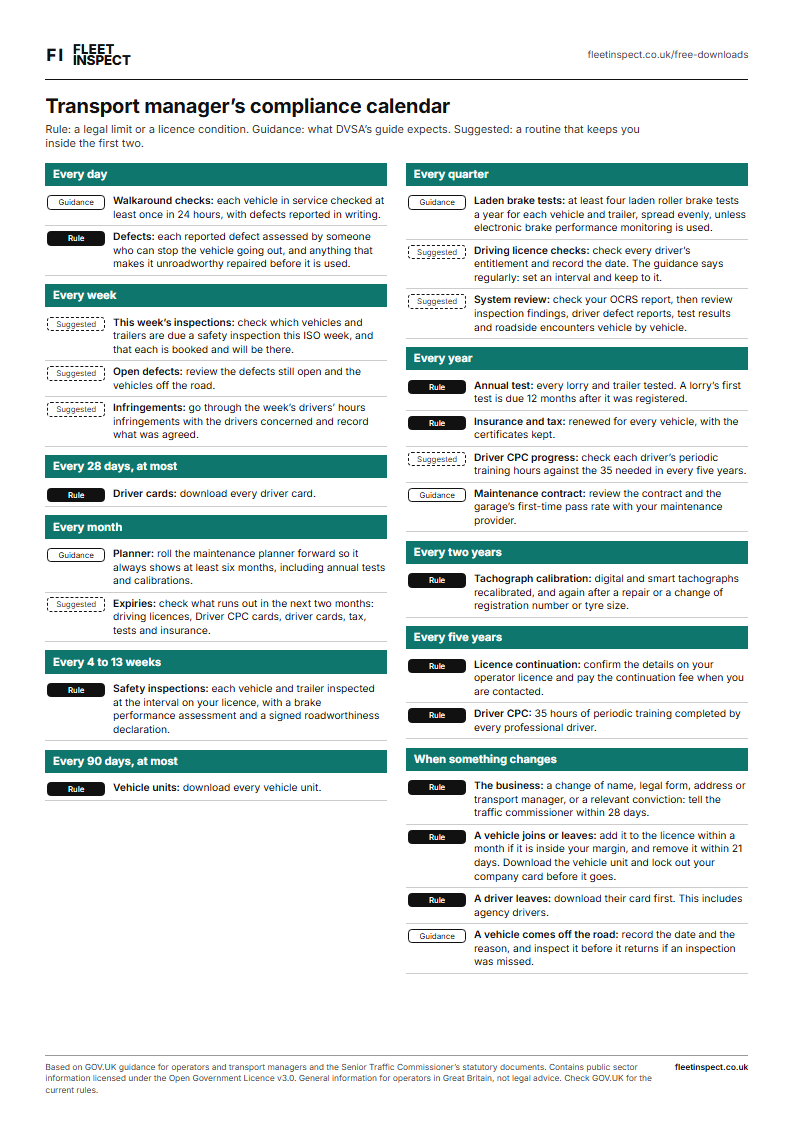
First page of the FleetInspect walkaround check sheet

Get the PDF

Tell us who you are and the sheet is yours.

Your details go to our team by email. Unless you tick the box, we will not use them to market to you. See our privacy policy.

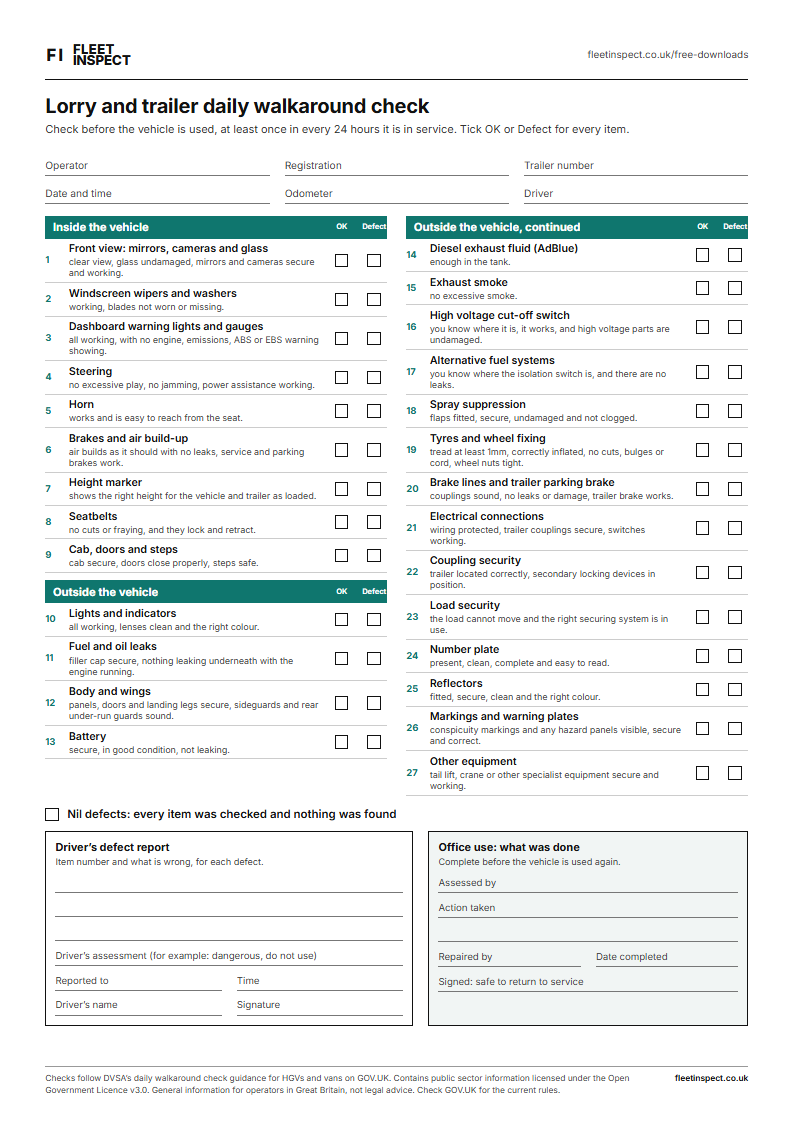
Lorry and trailer daily walkaround check

The 27 checks in DVSA’s guidance for heavy goods vehicles, in the same order.

Inside the vehicle

  • Front view: mirrors, cameras and glass: clear view, glass undamaged, mirrors and cameras secure and working.
  • Windscreen wipers and washers: working, blades not worn or missing.
  • Dashboard warning lights and gauges: all working, with no engine, emissions, ABS or EBS warning showing.
  • Steering: no excessive play, no jamming, power assistance working.
  • Horn: works and is easy to reach from the seat.
  • Brakes and air build-up: air builds as it should with no leaks, service and parking brakes work.
  • Height marker: shows the right height for the vehicle and trailer as loaded.
  • Seatbelts: no cuts or fraying, and they lock and retract.
  • Cab, doors and steps: cab secure, doors close properly, steps safe.
Outside the vehicle

  • Lights and indicators: all working, lenses clean and the right colour.
  • Fuel and oil leaks: filler cap secure, nothing leaking underneath with the engine running.
  • Body and wings: panels, doors and landing legs secure, sideguards and rear under-run guards sound.
  • Battery: secure, in good condition, not leaking.
  • Diesel exhaust fluid (AdBlue): enough in the tank.
  • Exhaust smoke: no excessive smoke.
  • High voltage cut-off switch: you know where it is, it works, and high voltage parts are undamaged.
  • Alternative fuel systems: you know where the isolation switch is, and there are no leaks.
  • Spray suppression: flaps fitted, secure, undamaged and not clogged.
  • Tyres and wheel fixing: tread at least 1mm, correctly inflated, no cuts, bulges or cord, wheel nuts tight.
  • Brake lines and trailer parking brake: couplings sound, no leaks or damage, trailer brake works.
  • Electrical connections: wiring protected, trailer couplings secure, switches working.
  • Coupling security: trailer located correctly, secondary locking devices in position.
  • Load security: the load cannot move and the right securing system is in use.
  • Number plate: present, clean, complete and easy to read.
  • Reflectors: fitted, secure, clean and the right colour.
  • Markings and warning plates: conspicuity markings and any hazard panels visible, secure and correct.
  • Other equipment: tail lift, crane or other specialist equipment secure and working.

Van daily walkaround check

The 19 checks in DVSA’s guidance for vans, in the same order.

Inside the van

  • Front view: mirrors, cameras and glass: clear view, windscreen undamaged, mirrors and cameras in place.
  • Windscreen washers and wipers: working and in good condition.
  • Dashboard warning lights: all working, including ABS, airbag and parking brake warnings.
  • Steering: moves smoothly, no excessive play, power assistance working.
  • Horn: works.
  • Brakes: footwell clear, foot brake and handbrake work without excessive travel.
  • Seats and seat belts: seats secure, belts undamaged, and they lock and retract.

Outside the van

  • Lights and indicators: all working, lenses clean and the right colour.
  • Fluids, fuel and oil: brake fluid, coolant, oil and washer fluid topped up, filler cap secure, no leaks.
  • Battery: secure, in good condition, not leaking.
  • Bodywork and doors: doors close and stay shut, no sharp edges or loose panels.
  • Tyres and wheels: tread at least 1.6mm, correct pressure, no cuts or cord showing, wheels secure.
  • Load: secured, doors and tailgate lock, bulkhead and floor sound.
  • Diesel exhaust fluid (AdBlue): enough in the tank, on diesel vans.
  • Exhaust: no leaks, and no excessive smoke or noise.
  • Alternative fuel systems: you know where the isolation switch is, and there are no leaks.
  • Number plate: the right type, secure and easy to read.
  • Tow bar and trailer: tow bar secure, trailer attached correctly, electrics working, breakaway cable fitted.
  • Other equipment: tail lift or other specialist equipment secure and working.

Getting the most from the walkaround check sheet

  1. Print one sheet per vehicle per day: or one for each check if a vehicle is double shifted. DVSA’s guide says at least one check in every 24 hours the vehicle is in service, before it goes on the road.
  2. Tick or cross every item: a blank box tells nobody whether the item was checked. If nothing is wrong, tick nil defects.
  3. Write up each defect: what is wrong, how serious the driver judges it to be, and who it was reported to. A dangerous defect has to be fixed before the vehicle is used.
  4. Fill in the office section: who assessed the defect, what was done and the date it was completed, before the vehicle goes back out.
  5. File it: sheets that record a defect are part of the maintenance record and must be kept for at least 15 months. The guide recommends keeping nil sheets for at least three months.

The digital walkaround check sheet

A paper sheet meets the requirement if it is filled in, handed in and acted on. The weak points are familiar: sheets that stay in the cab, handwriting nobody can read, and no way to show that the repair was done before the vehicle went back out.

In FleetInspect the same check is done in the driver app, with or without a signal. The checklist is yours to set, a defect carries a note and photos, and the office sees every check, including the ones with nothing to report.

Common
questions.

Is a daily walkaround check a legal requirement?

The driver is always responsible for the condition of the vehicle on the road, and DVSA’s guide says at least one walkaround check should be carried out in every 24 hours a vehicle is in service, before it is used. For operator licence holders, having drivers report defects promptly and keeping the records are promises made on the licence.

What has to be on a driver defect report?

DVSA’s guide lists the vehicle registration or identification mark, the date, the defect or symptoms, the driver’s assessment, the driver’s name, who it was reported to, the repair work and the date it was completed. This sheet has a space for each one.

How long do walkaround check sheets have to be kept?

A sheet that records a defect is part of the vehicle’s maintenance record and must be kept for at least 15 months, along with what was done about it. For nil defect sheets, the guide recommends at least three months.

Do vans need a daily walkaround check?

DVSA publishes a separate 19 point check for vans, and the driver is responsible for the van being safe to drive whatever its size. Recording and reporting the result applies to drivers working for a business with an operator licence, and it is good practice for any fleet.

Can the check be recorded digitally instead?

Yes. DVSA’s guide accepts electronic defect reporting in place of paper. It expects the records to be available on request, protected against later changes, date and time stamped, backed up, and to show an audit trail from the report to the repair.

Is this DVSA’s own form?

No. It is FleetInspect’s layout of the checks listed in DVSA’s guidance, with the report fields from the Guide to maintaining roadworthiness. DVSA publishes its own template alongside the guidance on GOV.UK.

Sources

Checks follow DVSA’s daily walkaround check guidance for HGVs and vans on GOV.UK. Contains public sector information licensed under the Open Government Licence v3.0.

General information for operators in Great Britain, not legal advice. Rules change: check the current position on GOV.UK before relying on it. In Northern Ireland the DVA and the Department for Infrastructure apply their own versions of these rules, and in Ireland the Road Safety Authority does.

Let’s talk about
your business.

Book a free, no-obligation demo and see how FleetInspect can transform your operations. One email is all it takes.

Email us

The link opens a ready-made email in your mail app. Tell us a little about your business and we’ll come back with demo times.

Prefer to call?
We reply within one working day